
Solutions
Mobility Rights Platform — Parking and Urban Access Management for Cities
Every mobility right. One platform. Local control.
Every time someone parks, enters a low-emission zone, loads and unloads or charges a car, they need a mobility right. Mobility Rights Platform gives you one open, neutral platform to manage them all.
Deployed by cities and concessionaires.
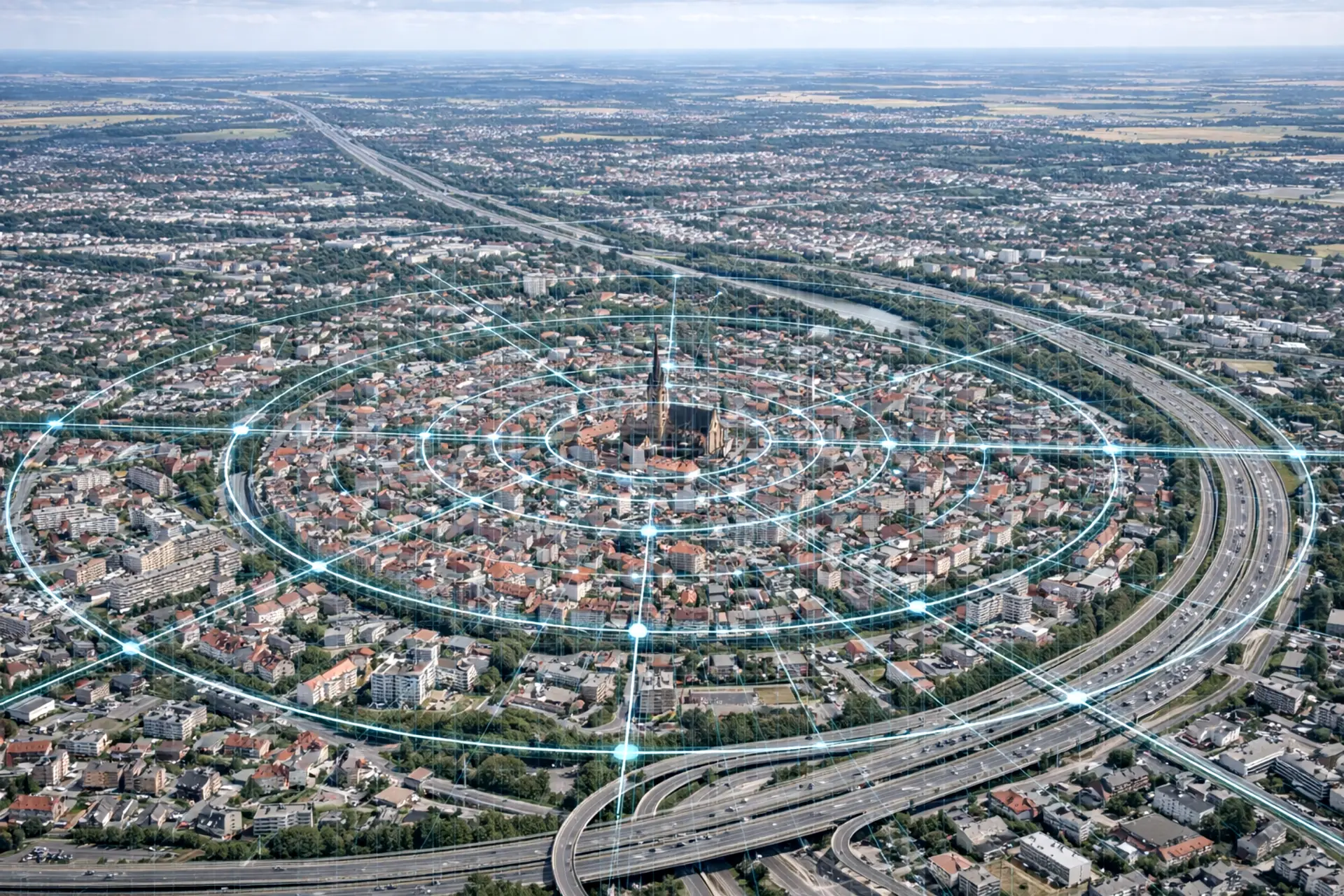
ONE PLATFORM · NINE MODULES
Manage parking, permits, vouchers, fines, EV charging and urban access from one platform
A mobility right is the permission you grant to a vehicle or person to use public space: to park in a specific zone, to enter a restricted area, to load and unload within a time window, to charge a car, and so on. Every right has a holder, a location, a period and a set of local conditions.
Short-term parking is roughly 4% of the rights a city manages, and the other rights each sit in their own system. Mobility Rights Platform brings nine of them together.
On-street parking
A short-term right to park in a zone, paid per session.
Permits
A long-term parking right paid upfront, such as a resident permit.
Vouchers
A free or discounted parking right you hand to visitors, carers or customers.
Fines
The charge that follows when a vehicle parks without a valid right.
EV charging
A digital right tied to a charging session at a public charge point.
Delivery rights
Time-limited access for freight and last-mile delivery.
LEZ
Access based on the emission standard of the vehicle, per zone.
Tolling
A plate-based right to enter an urban charging zone.
Urban access
More urban access rights are being added continuously.
INSIDE THE PLATFORM
Where every mobility right is set, stored, checked and measured
For each right you configure your own rules and workflows, on top of one central rights and citizen database, with administration, enforcement and performance logs in the same platform.
Rule engines
Each right has its own rule engine to set zones, tariffs, time windows, vehicle categories, exceptions and validity dates.
Rights and citizen database
Every right that is active, requested or under review sits in one database, linked to the holder and the vehicle.
Admin portal
Your team handles permit and voucher requests, payments, fines and citizen communication from one role-based interface.
Citizen portal
Where citizens request and manage their mobility rights digitally, so a permit, voucher or exemption can be applied for without going through the counter.
Enforcement
Scan cars, cameras and handhelds check the same database through one API, and every check is logged.
Performance
See how each right is used, how enforcement performs and where your policy needs adjusting.
HOW IT WORKS
From the rule you set to the check on the street
Every mobility right you activate runs the same way. Adding a right adds rules, not systems.
- 01
You set the rule
You define the zone on the map and set the tariff, the time windows, who is exempt and when the rule starts. Test it first and plan the go-live date before anything changes on the street.
- 02
The rule goes live everywhere at once
From that moment every connected app, parking meter and portal works from it. No calls with individual providers, and no channel running its own tariff table.
- 03
The right is stored centrally
Every session, permit or voucher is written to the same rights database, linked to a plate and a period. The right exists digitally from that moment, whether it was requested online, at the counter or on paper.
- 04
Enforcement checks that same database
A scan car, camera or handheld sends the plate, the location and the photos through one enforcement API, and gets an answer on every active right at that place and time in under 500 milliseconds.
IN PRACTICE
Change your policy for a single afternoon
A city expects a full stadium on Sunday. For the hours before, during and after the match it raises the tariff in the streets around the ground, for that day only, so residents keep more space and visitors are guided to the underground car parks instead. The rule is configured once, applies across every app and every meter for those hours, and reverts by itself afterwards.
FINES AND ENFORCEMENT
What happens when a car parks without a valid right
Enforcement runs on a configuration you set once: the zones, the charge per zone, which databases are checked during a control, and how follow-up should be handled. After that, every case follows the same path.
A scan car, camera or handheld sends the plate, the location and the photo evidence through one enforcement API, whichever brand of hardware you use. The platform checks every right that was active at that location and at that moment, and answers in under 500 milliseconds. If there was a valid session, permit or voucher, nothing happens. If there was none, a fine is created with the tariff, the zone, the duration and a payment link.
Your team reviews the case before it goes out. Reminders and standard complaints then run on the rules you already set, so staff time goes to the exceptions instead of to the backlog.
EVERY CASE ON ONE SCREEN
- Location of the offence.
- Vehicle registration details.
- Every right that was active at that moment.
- The driver's complaint.
OPEN ECOSYSTEM · LOCAL CONTROL
Your rules apply to everyone who connects
Providers apply to connect, you decide who operates in your city and under which conditions. Your residents keep paying in the apps they already use.
Cities and concessionaires
Activate only the modules you need and set your own zones, tariffs and eligibility rules. You decide which certified providers may operate and under which local conditions. Your rights and citizen data stay yours.
Service providers
Providers connect once and can then serve every location that runs on the platform, without building a separate integration for each city. The largest parking apps in the Benelux are already connected, so switching one on is a decision, not a project for your team.
Citizens
Residents and visitors pay for a mobility right in the app they already use, with the same tariffs and zones everywhere. Anyone who would rather not use an app can arrange their rights through your own portal or the Citizen Portal.
How providers are approved and connected
Certification before go-live
Every provider passes legal, financial, operational and technical certification before it can operate in your city, and that certification is renewed every year.
Continuous monitoring and settlement
Live connections are monitored, so a provider that stops meeting your conditions does not quietly keep running. The platform collects the fees, verifies the amounts and arranges payment to you or to your concessionaire.
You stay in control
You choose which certified providers are available in your city, from when, and under which local conditions. Providers connect through one documented API for the service they deliver, so adding or removing one is a decision you make, not a project you have to plan.
CONNECTED BY DESIGN
Connect to the systems you already use
Mobility Rights Platform connects to the government sources your city already relies on, so identity, address and vehicle data are validated automatically instead of being requested from your residents.






FAQ
Frequently asked questions
See Mobility Rights Platform in action
Get a guided tour of every mobility right in one shared platform, or explore the integration details with our team.
Explore More